
A wood deck in Southwest Washington takes a beating from more than foot traffic. It cycles through long wet stretches, cool shaded mornings, summer sun, pollen, leaves, dirt, and the organic growth that shows up anywhere moisture lingers. That makes the choice of deck stain more than a color decision.
The best stain for a Vancouver-area deck depends on what the wood looks like now, what finish is already on it, how much of the natural grain you want to preserve, and how exposed the deck is to weather. A new cedar deck with beautiful, even boards may call for a very different product than a 15-year-old deck that has been cleaned, repaired, and refinished several times.
The easiest way to understand the options is by opacity: transparent, semi-transparent, semi-solid, and solid stain.
What Does Deck Stain Opacity Mean?
Opacity describes how much of the wood you can see through the finished stain. At the transparent end, the grain and natural variation remain highly visible. At the solid end, the color becomes much more uniform while the wood texture can still show.
This matters because stain is doing two jobs at once. It is changing or enhancing the appearance of the deck while also helping protect the wood from weather. The condition of the wood should influence how much you ask the finish to hide.
A common mistake is choosing a stain solely from a color chip. The same color can look very different depending on opacity, wood species, age, previous coatings, and surface preparation. Testing the product on the actual deck is much more useful than judging it from a small printed sample.
Transparent Stain: Best When You Want the Wood to Be the Star
Transparent or translucent stain is designed for homeowners who want to preserve as much of the wood’s natural appearance as possible. It adds tone and protection without covering the grain pattern.
This option is most attractive on newer wood or boards that are still visually consistent. If the deck has heavy weathering, patch repairs, dark water marks, or boards replaced at different times, a transparent finish will not hide those differences. In fact, it can make them more noticeable because the wood remains visible.
For a high-quality cedar deck in good condition, that may be exactly what you want. The goal is not to make it look painted. The goal is to show the material.
Semi-Transparent Stain: A Popular Middle Ground
Semi-transparent stain allows much of the grain and texture to remain visible while adding more color than a transparent finish. For many homeowners, this is the practical middle ground between a very natural appearance and a more uniform color.
It can work well when the deck has aged but the wood is still in good overall condition. Slight color variation can be softened without erasing the character of the boards.
Semi-transparent stain is also useful when you want the deck to coordinate with siding or trim without turning the deck into one solid block of color. Warm browns, grays, cedar tones, and muted neutrals can tie an outdoor space into the house while still reading as stained wood.
Semi-Solid Stain: More Color, Some Grain
Semi-solid stain provides greater hiding power while still allowing some wood character to come through. It can be a strong option for decks that have more visible aging or mismatched boards but do not need the fully uniform look of a solid stain.
Think of it as a transition option. You still see texture and some variation, but the overall color becomes more consistent. On an older Clark County deck that has been repaired over the years, that extra opacity can help bring new and old boards visually closer together.
As with every stain, the existing finish matters. Switching products or opacity levels may require more preparation than simply applying another coat over what is already there.
Solid Stain: Best for a More Uniform Look
Solid stain is the most opaque of the common deck stain categories. It hides most of the wood grain while leaving the surface texture visible. This can make it a good fit for older, weathered decks where the boards are structurally serviceable but no longer uniform enough for a transparent finish.
Solid stain also gives homeowners a wider visual reset. If you want the deck to coordinate closely with the home’s trim, railing, or exterior palette, the more uniform color can be helpful.
But solid stain does not eliminate the need for preparation. Peeling old finish, algae, dirt, failed coatings, and rough fibers still need to be addressed. A more opaque product is not a shortcut for a compromised surface.
In Vancouver, Preparation Is the Real Difference Maker
Homeowners often spend most of their time comparing stain colors. The more important question is whether the wood is ready to accept the stain.
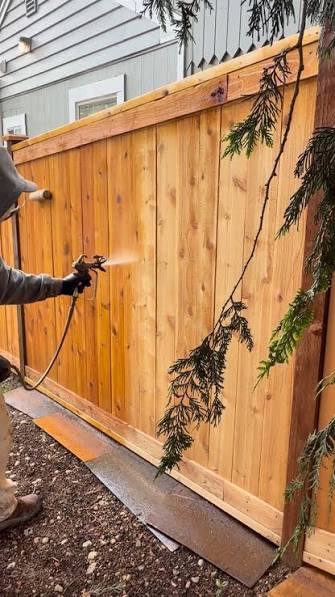
A professional deck refinishing process may include cleaning away dirt and organic growth, removing a failing previous finish when necessary, brightening or restoring weathered wood, sanding rough areas, and allowing the deck to dry before application. The exact sequence depends on the deck and the product being used.
Benjamin Moore’s deck guidance, for example, emphasizes thorough cleaning and sanding and directs users to allow cleaned wood to dry before staining. Product instructions vary, so the selected stain’s label and data sheet should always control the final application process.
The Pacific Northwest makes this preparation especially important. A deck can look dry on top while shaded joints, end grain, or boards close to the house are still holding moisture. Rushing that stage can create a finish problem that no premium stain can fix afterward.
How Weather Exposure Should Affect Your Choice
Not every deck on the same street lives in the same environment.
A south- or west-facing deck may receive intense summer sun and dry rapidly after rain. A deck tucked against a tree line may stay shaded, collect leaves, and remain damp for long periods. Covered decks have less direct rainfall but may still deal with moisture and low airflow. Stairs and horizontal handrail surfaces can weather differently from vertical balusters.
Those conditions influence product choice, preparation, and maintenance. They also influence color. Darker finishes can look dramatic, but they may feel hotter in direct summer sun. Very light finishes can show dirt and organic staining more readily. The right answer depends on how the deck is actually used.
Do Not Choose a Deck Stain Based Only on “How Long It Lasts”
Homeowners naturally ask which stain lasts the longest. The problem is that durability is not determined by opacity alone.
Wood condition, prep quality, previous coatings, sun exposure, moisture, foot traffic, application thickness, and the specific product all matter. A premium stain applied to poorly prepared wood can fail sooner than a more modest product applied correctly to a sound surface.
A better maintenance habit is to inspect the deck regularly instead of waiting for a dramatic failure. Look for areas where water no longer beads or sheds as expected, color has faded unevenly, wood fibers are exposed, finish is lifting, or high-traffic paths look noticeably different from protected areas.
Catching maintenance early can make the next refinishing cycle simpler.
Which Deck Stain Is Right for Your Home?
Choose transparent stain when the wood is attractive and you want maximum grain visibility. Choose semi-transparent when you want a balance of natural character and color. Consider semi-solid when the deck needs more visual uniformity without completely hiding the wood. Choose solid stain when the deck is more weathered or when a strong, consistent color is the priority.
Then make sure the preparation matches the finish.
Elite Edge Painting provides deck staining and sealing for homeowners in Vancouver, Camas, Washougal, and surrounding Clark County communities. We evaluate the existing finish, clean and prepare the wood, and help match the stain opacity and color to the deck you actually have. Call (360) 550-0237 or request a free estimate to talk through your deck before the next dry weather window.