

We are a 5 ⭐ Rated Business on Google
Vancouver, WA's #1 Deck Staining And Sealing Company
CALL FOR A FAST FREE ESTIMATE
(360) 550-0237

Deck Staining And Sealing Services You Can Count On In Vancouver, WA
A deck is the hardest working exterior surface on a Vancouver home. It faces straight up at eight months of rain, holds standing water instead of shedding it, grows algae in every shaded corner, and gets walked on the whole time. That combination is why deck finishes fail faster than anything on the house, and why a deck left unsealed for a few Clark County winters goes gray, gets slick, and starts cupping at the boards.
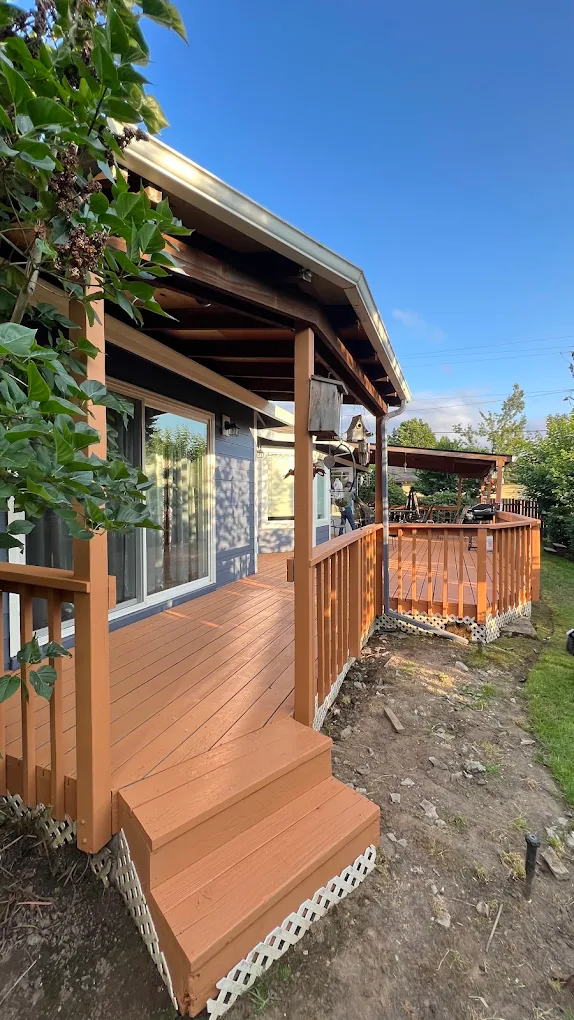
Our team provides professional deck staining and sealing in Vancouver, WA for cedar, pressure treated, and hardwood decking, including railings, stairs, and skirting. The work is mostly preparation. We assess whether the old finish needs stripping or just cleaning, wash at a pressure that will not shred the boards, treat the algae and mildew rather than blasting the surface growth off, and wait for the wood to reach a moisture level that will actually take the coating. Then the stain goes on and gets worked into the grain. We also look at the structure while we are there, because a deck is the one exterior surface where a rotted board is a safety problem rather than a cosmetic one.
SHORT ON TIME & CAN’T CALL? GET A FAST QUOTE TODAY!

Fast Free Estimates On Your Schedule

Prep Work Done The Right Way

Premium Paints That Show It

Locally Owned. Vancouver Focused.
CERTIFICATIONS AND AFFILIATIONS
When Should You Call A Deck Staining And Sealing Company In Vancouver, WA?
1. When Your Deck Has Gone Gray And Rough
2. When The Deck Is Slick In The Morning
3. When The Old Stain Is Peeling Or Blotchy
4. Before Water Stops Beading On The Boards
5. When Boards Are Cupping, Splitting, Or Springy Underfoot
6. Before You List Your Vancouver Home
What Is Our Process Like When Doing Deck Staining And Sealing Work In Vancouver, WA?
Our deck process in Vancouver, WA starts with assessing what is actually on the boards, because that determines whether this is a wash and recoat or a strip and restore. We test how the existing finish is holding, check whether water beads or absorbs, identify the decking material, and look at the railings, stairs, and skirting separately since those weather differently than the deck floor. We also check the structure, probing joists and posts where accessible, looking at the ledger connection to the house, and checking for popped fasteners and soft boards, because none of that gets better under a coat of stain.
Once work begins, we clear the deck, protect the siding, landscaping, and any hard surfaces below, then clean the surface. Where the old finish is largely gone, that means washing and treating the algae and mildew. Where a failing finish is still partly bonded, that means stripping or sanding so the new product has uniform bare wood to penetrate. Then the deck dries, and on a horizontal surface in the Pacific Northwest that takes longer than people expect, because deck boards hold water in a way vertical siding does not.
When the moisture level is right, the stain goes on and gets worked into the grain rather than left sitting on the surface, with railings, stairs, and skirting coated as well. We finish by inspecting the whole deck, touching up areas that absorbed unevenly, and telling you exactly how long before furniture goes back on.
Specific Work Practices Include:
- Our process starts with assessing the existing finish and the decking material, testing whether water beads or absorbs, and checking railings, stairs, and skirting separately. We also inspect the structure for soft boards, popped fasteners, and the condition of joists, posts, and the ledger where accessible, and flag anything that needs attention before coating.
- Once work begins, we clear and protect the area, then either wash and treat the surface or strip and sand it depending on how the old finish is holding. Algae and mildew are killed rather than surface removed, and the deck is then allowed to dry to a moisture level that will actually accept a coating.
- With the wood dry, we apply the stain and work it into the grain, coating the deck floor along with railings, stairs, and skirting. We inspect the full surface, touch up uneven absorption, and give you a clear timeline for when the deck can be walked on and when furniture can return.
We've Been Doing Deck Staining And Sealing In Vancouver, WA For Years!
We have been restoring and sealing decks in Vancouver, WA for years, and the pattern is consistent. Homeowners call when the deck has gone gray, the boards feel rough, and something slipped underfoot in the rain. Most of those decks are entirely recoverable. Some have a board or two that need replacing first, and a few have framing issues that need a carpenter before anyone puts stain on them. We tell people which one they have.
That experience shows up in the parts that are easy to rush. Correctly reading whether a deck needs stripping or just cleaning. Washing at a pressure that cleans without furring the boards. Killing the algae rather than knocking it off. Waiting for a horizontal surface to actually dry, which is not the same timeline as a fence. Working the stain into the grain instead of flooding it on. Decks are the shortest lived exterior finish there is, so the prep is the only thing that buys you extra seasons.
Our Deck Staining And Sealing Service Includes:
- Free walkthrough with decking material, existing finish, and condition assessed upfront
- Structural check of boards, fasteners, posts, and ledger connection where accessible
- Protection of siding, landscaping, and any surfaces below the deck
- Washing, stripping, or sanding depending on how the existing finish is holding
- Treatment of algae, moss, and mildew so growth is killed rather than surface removed
- Proper dry down time on a horizontal surface before any coating goes on
- Stain applied and worked into the grain across deck boards, railings, stairs, and skirting
- Clear guidance on when the deck can be walked on and when furniture can return
- Final inspection, touch ups, and complete site cleanup
Get a Quote Today!
Frequently Asked Questions
Yes. Elite Edge Painting cleans, restores, and seals decks for homeowners throughout Vancouver, WA and the surrounding Clark County area. We work on cedar, pressure treated, and hardwood decking, and every project covers the deck floor along with railings, stairs, and skirting. Depending on the condition, that means washing and recoating or stripping and sanding back to bare wood first. We also check the structure while we are there, since a deck is the one exterior surface where a soft board is a safety issue. Locally owned, licensed and insured, free estimates. Call (360) 550-0237.
Because a deck is horizontal, and that changes everything. Siding sheds water within minutes of a rain stopping. A deck holds it, in the grain, in the gaps, and in the channel of any cupped board, and in Vancouver that water sits there through most of the winter. A deck also faces straight up at whatever UV we get, has no eave protecting it, and gets walked on daily, which no vertical surface does. Add furniture legs, planters that trap moisture underneath, and pets, and you have the hardest working exterior surface on the property. Expecting a deck to hold a finish as long as siding does is the most common unrealistic expectation homeowners bring to this work.
The deck floor generally needs attention every two to three years here, and with a transparent product sometimes annually. Railings and skirting last considerably longer because they are vertical and shed water, so it is common for a deck to need the walking surface redone twice before the rails need anything. The simplest test is water. Pour a cup on the boards, and if it soaks in and darkens the wood rather than beading, the seal is gone. Staying on a regular cycle is far cheaper than letting a deck go, because a maintained deck needs a wash and a coat while a neglected one needs stripping, sanding, and sometimes new boards.
It depends on how the existing finish is holding, and getting this call right determines whether the job looks good or looks blotchy. If the old finish has worn away almost entirely, washing and treating the surface is usually enough. If it is still bonded in the protected areas but gone in the open, recoating produces a patchwork, because the sealed sections will not absorb anything while the bare sections drink it up. That deck needs stripping or sanding to get a uniform bare surface. Solid stains and anything film forming almost always need full removal once they start failing. We test several areas at the walkthrough rather than assuming from a photo.
Not the walking surface, no. Paint forms a film on top of the wood, and on a horizontal surface that takes standing water and foot traffic, that film eventually lifts and peels, at which point your only options are stripping the entire deck or living with it flaking. Water that gets under a paint film on a deck board also has nowhere to go and rots the wood from beneath while the surface still looks intact. Stain penetrates instead, wears away gradually, and is renewed by washing and recoating. Railings and skirting are a different matter, since they are vertical and paint holds up fine there, and painted rails with a stained deck floor is a common and durable combination.
Usually, because the slipperiness is almost always algae rather than the wood itself. Every Vancouver deck grows a green film in the shaded areas, under the table, along the house wall, and anywhere a tree overhangs, and it becomes genuinely hazardous once it is wet. Simply pressure washing knocks the visible growth off but leaves enough in the grain to return within a season. It needs treating with a solution that kills it, then sealing with a product that resists regrowth. We also point out what is feeding it, most often overhanging branches, a planter sitting directly on the boards, or a gutter dumping onto one section of the deck.
Longer than a fence, and that surprises people. Deck boards are horizontal, so water sits on and in them rather than running off, and the underside stays shaded and damp. After washing, a deck typically needs several dry days before the moisture content is low enough for stain to penetrate, and in cooler months it can take longer. Staining a deck that still holds water is the single most common cause of early failure, and it looks fine for about six weeks before it starts going blotchy. This is why we will not wash and stain a deck on the same day, and why our schedule depends on the forecast rather than convenience.
Summer, primarily, because you need a consecutive dry stretch long enough to wash, dry, and coat. June through September is the reliable window in Clark County, with good weeks in May and September often workable. We avoid staining in full midday sun on a hot deck, since the product flashes off before it can penetrate, so on hot days we work early or follow the shade around the deck. Booking early genuinely matters for this service, because deck and fence work compresses into the same few months here and the calendar fills fast. Calling in late winter puts you in the first good stretch rather than waiting behind everyone who called in July.
Decks are priced on square footage of the walking surface plus linear footage of railing, and the single biggest variable is whether the old finish needs stripping. A maintained deck that just needs washing and a coat costs a fraction of one that has been neglected for a decade and requires stripping, sanding, and heavy algae treatment. Railing style matters a lot too, since a run of individually turned balusters takes many times longer than a simple horizontal rail or a cable system. Stairs, skirting, and multi level decks add labor. We measure the whole thing and give you a written estimate with the scope spelled out. Call (360) 550-0237.
We check the structure, because a deck is the one exterior surface where a rotted component is a safety issue rather than a cosmetic one. During the walkthrough we probe accessible joists, beams, and posts, look at the ledger where the deck attaches to the house, check for corroded or popped fasteners, and test any board that feels springy underfoot. We are painters rather than structural engineers, so if we find something concerning we tell you plainly and recommend having a contractor look at it before we coat anything. Sealing a deck with compromised framing just puts a nice finish on a problem. Ledger connections in particular are worth attention, since that joint is where serious deck failures begin.
Boards that are gray and rough but still solid clean up and seal fine, and heavy splintering can often be addressed by sanding. Boards that are soft, cracked through, or cupped badly enough to hold standing water need replacing before staining, because sealing them just extends the problem under a nicer surface. The board ends and anywhere a board sits over a joist are the usual failure points, since water collects at those contact areas. We flag every board we think needs replacing at the walkthrough so you can decide whether to handle it first. New replacement boards also need to weather before they will take stain the same way the old ones do.
Composite decking cannot be stained the way wood can, because there is no grain for a penetrating product to soak into. What composite does need is cleaning, since it grows mold and algae readily in our climate, particularly in shaded areas and in the grooves of textured board profiles, and many homeowners assume composite is maintenance free right up until it goes green. There are coatings made specifically for composite surfaces, though results vary considerably by brand and age of the decking, and we are honest about the limitations rather than promising a wood like result. If your deck is composite, tell us at the walkthrough so we quote the right thing.
Yes, they are part of a complete deck project. Railings take significantly more labor than the deck floor per square foot, especially with turned balusters where every spindle has four sides and two tight corners, which is why railing style affects the quote more than most homeowners expect. Stairs get heavy wear and are worth a durable product since they are also the most consequential place for a slick surface. Skirting and fascia around the deck edge are often forgotten and are exactly where splash back does its damage. If you want to phase the work, the deck floor is the priority since it fails first, and rails can follow.
Light foot traffic is usually fine within a day, but furniture should stay off considerably longer, and this is where a lot of otherwise good deck jobs get ruined. Setting a heavy table or planter down on a finish that has not fully cured leaves permanent marks where the legs sat, and rubber or plastic feet can stick to the surface and pull it. Damp Vancouver conditions extend cure times, so we give you a specific timeline for the product used and the weather rather than a generic number. Grills, planters, and anything heavy should be last back on. Planters should ideally sit on feet or a stand rather than directly on the boards permanently.
Yes, the deck needs to be completely clear before we start. Furniture, grills, planters, rugs, and storage all need to come off, and they need to stay off for the duration of the project rather than getting moved from one half to the other, since we work across the full surface. Plan somewhere to put it, because a full deck's worth of furniture takes more space than people estimate. It also helps to trim back overhanging branches and anything growing against the skirting. If moving heavy items is a problem, tell us at the walkthrough and we can discuss it rather than having it become a delay on day one.
Pigment is what provides UV protection, so the more pigment a product carries the longer it lasts. Transparent stains show the most grain and look the most natural but need the most frequent renewal, often annually on a deck floor here. Semi transparent carries more pigment while still showing grain and is the most common choice for cedar decking in Clark County. Solid stain lasts the longest but sits closest to the surface, so on a walking deck it is more prone to wearing in traffic paths and is difficult to reverse later. The honest tradeoff on a deck floor is appearance versus how often you want us back, and we lay that out at the walkthrough.
The project spans about a week for a typical deck even though crew time on site is shorter. Washing or stripping takes a day, the deck then dries for several days depending on weather, and coating takes a day. A deck needing heavy stripping and sanding, or a large multi level deck with extensive railings, will run longer. Rain during the dry down window resets the clock, which is why we build in buffer and why deck work is scheduled around the forecast rather than a fixed date. Add cure time on the back end before furniture returns. We give you the realistic full timeline at the estimate.
Yes, and it is worth asking about because combining them saves money. Both projects need the same equipment, the same setup, and the same weather window, so doing them together means one mobilization instead of two. Matching or coordinating the colors also makes a backyard look considerably more finished than a deck and fence in two unrelated tones. The scheduling works out naturally too, since the fence can be washed and coated while the deck is in its dry down window. Mention it at the walkthrough and we will quote both together so you can see the difference against doing them separately.
Elite Edge Painting serves homeowners throughout Vancouver, WA and the surrounding Clark County area including Camas, Washougal, Battle Ground, Ridgefield, Hazel Dell, Salmon Creek, Felida, Orchards, Brush Prairie, Hockinson, La Center, and the greater Portland metro area. If you are not certain whether your address falls inside our service area, call us and we will confirm right away. Being local matters more on deck work than almost anything else we do, because the entire schedule depends on reading the weather window correctly, and that is a judgment a crew based here makes better than one driving in from elsewhere.
Call Elite Edge Painting at (360) 550-0237 or send us a message through the contact form and we will come out to look at your deck. At the walkthrough we measure the surface and railings, test how the existing finish is holding to determine whether stripping is needed, check the boards and accessible structure for soft spots and failed fasteners, assess the algae situation, and talk through which stain type fits how often you want this done. You get a written quote with the scope spelled out, including any boards we think should be replaced first. No pressure and no obligation. Locally owned, licensed and insured.
There Are Plenty Of Deck Staining Companies In Vancouver, WA
So Why Choose Our Company?

Free Estimates & On-Time Service

Premium Paints, Done The Right Way

Proven Craftsmanship That Shows

Vancouver Owned. Vancouver Focused.
Based In Vancouver, WA
Based in Vancouver, WA, Elite Edge Painting serves homes and businesses across Clark County and the Portland metro area with free estimates, premium finishes, and dependable, on time results.
- Vancouver, WA
- Camas, WA
- Washougal, WA
- Battle Ground, WA
- Ridgefield, WA
- Brush Prairie, WA
- Hazel Dell, WA
- Salmon Creek, WA
- Felida, WA
- Orchards, WA
- La Center, WA
- Hockinson, WA
- Portland, OR
- Beaverton, OR

Ready To Give Your Home A Fresh Coat? Let's Talk.
Contact Us Today!
CALL FOR A FAST FREE ESTIMATE
(360) 550-0237